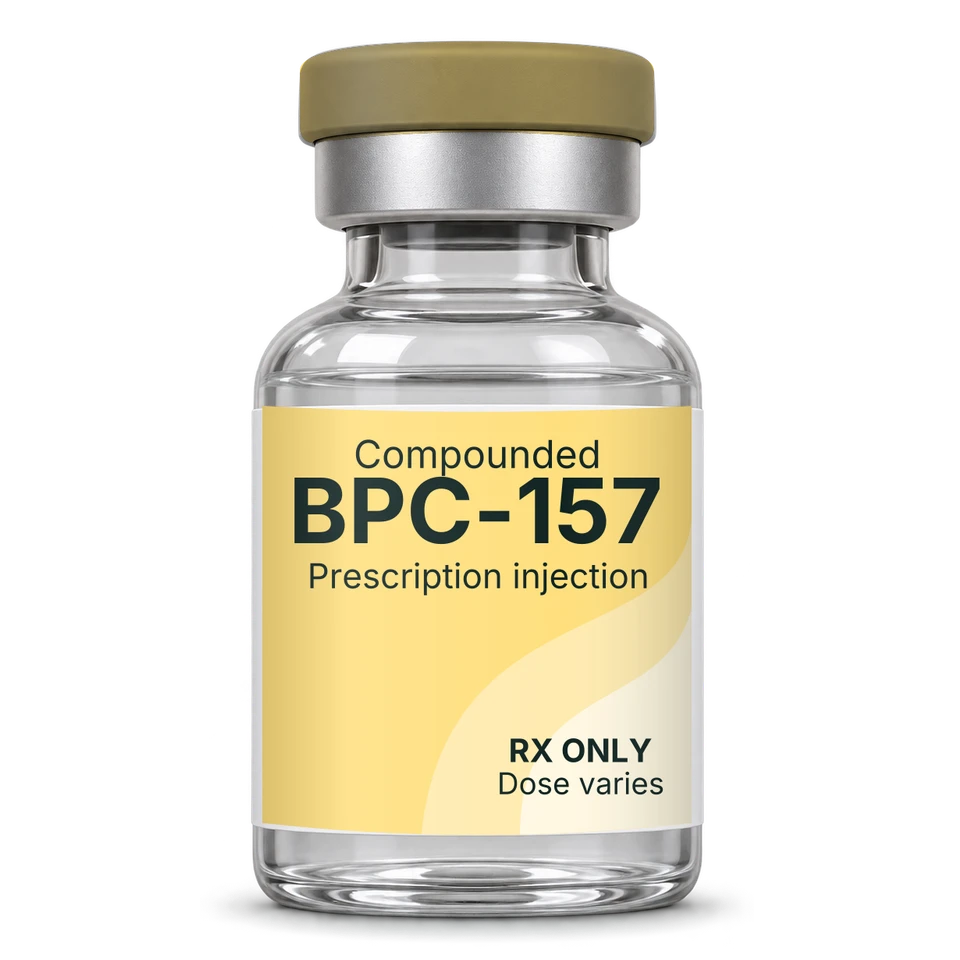


BPC-01BPC-157
A clinician-prescribed peptide formulated to support soft-tissue recovery, joint comfort, and active lifestyle resilience as part of a personalized care plan.
$159/mo
Prescription required; a licensed clinician decides if it’s appropriate.
Start the screener 2 min screenerPrivate online screener. A licensed US clinician reviews every request.
What it is
What it is, and what it’s studied for:
- A lab-made peptide of 15 amino acids, based on a protein in gastric juice
- Studied for tendon, ligament, muscle and bone repair in animal injury models
- Studied for protecting the stomach and gut lining
- Given as a small injection under the skin, with clinician check-ins
Investigational and not FDA-approved. Results are not guaranteed.
How it’s taken
As a subcutaneous injection, just under the skin, with a new sterile syringe each time. Your clinician sets the dose and schedule, and you get written instructions.
Who prescribes
A licensed US clinician reviews your screener and health history, then decides whether BPC-157 is appropriate for you. If it isn’t, they’ll tell you why.
Safety information
BPC-157 is not FDA-approved, and its safety in people has not been established. Not for use during pregnancy or breastfeeding. Prohibited in tested sport. Injections can cause redness or irritation where the needle goes in. Tell your clinician about every condition and medication.

The potential benefits of BPC-157.
What researchers have reported so far, mostly in animal and lab studies. Benefits in people are not yet proven.
-
Tendons and ligaments
In animal injury models, researchers reported that tendons and ligaments healed with better strength and function.
-
Muscle repair
Animal studies of muscle injury reported improved repair and a better recovery of function.
-
Bone healing
In animal studies, BPC-157 was linked with improved healing after bone injury.
-
The gut lining
First found in gastric juice, BPC-157 helped protect the stomach and gut lining in lab and animal studies.
Investigational. BPC-157 is not FDA-approved, human research is limited, and results are not guaranteed.
Who BPC-157 may be for.
People who ask about BPC-157 usually have one of these reasons. Open one to read more.
BPC-157 is investigational and not FDA-approved. Most research is in animals and cells, and individual results are not guaranteed. A licensed clinician reviews your health history, potential benefits and risks, and decides if it’s appropriate. It does not replace established treatment.

Training Hard, Recovering Slower?
Active adults often look at BPC-157 as one part of a wider recovery plan. In animal studies, it was linked with better healing of injured muscles, tendons and ligaments. Competing in tested sport? It’s banned under anti-doping rules.
Training Hard, Recovering Slower?
Active adults often look at BPC-157 as one part of a wider recovery plan. In animal studies, it was linked with better healing of injured muscles, tendons and ligaments. Competing in tested sport? It’s banned under anti-doping rules.
A Strain That Won’t Settle?
When a soft-tissue injury is slow to heal and first-line care hasn’t helped, some people ask a clinician about BPC-157. In animal injury models, researchers reported stronger, better-functioning tendons and ligaments.
Knees That Keep Reminding You?
In one small report, 7 of 12 people with chronic knee pain said an injection into the knee eased their pain for more than six months. It had no comparison group, and this prescription is given under the skin instead.
When Your Gut Needs Support.
BPC-157 is based on a protein in gastric juice. Lab and animal studies looked at how it may help protect the stomach and gut lining, and people whose gut irritation hasn’t eased with first-line steps sometimes explore it.
Part of a Longer-Term Plan?
Some people consider BPC-157 within a broader wellness or longevity routine, alongside training, sleep and nutrition, with a licensed clinician keeping an eye on it.
Done With Research-Only Vials?
Vials sold online as “not for human use” come with no prescriber, no pharmacy and no one to call. Here, a licensed clinician decides, and a licensed US compounding pharmacy prepares it for you alone.

How does BPC-157 work?
The leading ideas, in three steps. Most of the research is in cells and animals, and researchers are still working out the details.
-
01A short peptide chain
BPC-157 is a lab-made chain of 15 amino acids, modelled on part of a protein found in gastric juice.
-
02Studied in labs and animals
In lab and animal studies, BPC-157 appears to protect cells, encourage new blood vessel growth and work with growth factors and the nitric oxide system, all part of how tissue repairs. Whether this holds in people isn’t known yet.
-
03Prescribed and checked on
There’s no FDA-approved dose. If your clinician prescribes it, they set the amount and schedule, then check in with you. Not everyone responds.
This describes proposed mechanisms from early research. BPC-157 is investigational and not FDA-approved. Results are not guaranteed.
One Peptide. Prescribed to You.
BPC-157 is a single peptide, a chain of 15 amino acids, compounded as a single-ingredient injectable and given as a small subcutaneous injection on the schedule your clinician sets.
There is no FDA-approved dose of BPC-157. If a licensed clinician decides it’s appropriate, they set the amount and schedule, and may change or stop it at any check-in.


Progress Over Time.
If your clinician prescribes BPC-157, care follows a simple rhythm of check-ins. What you notice, if anything, varies from person to person.
-
Week 1
Getting Started°
- Your clinician reviews your history and decides if BPC-157 is appropriate
- If prescribed, learn the injection steps with written instructions
- Start a simple log of how you feel, sleep and train
-
Week 4
First Check-In°
- Talk through how you’re tolerating it
- Report any injection-site reactions or side effects
- Your clinician adjusts, pauses or stops as needed
-
Week 8
Taking Stock°
- Look back at your log with your clinician
- Decide together whether to continue, pause or stop
- Some people notice no difference, and that’s useful to know
-
Ongoing
Supported, Not on Autopilot°
- Continue only if your clinician recommends it
- Check in whenever something changes
- Your clinician follows new research and guidance as it emerges
°Illustrative care milestones, not guaranteed outcomes. BPC-157 is investigational and not FDA-approved. Response varies, and some people notice no change.
Questions, answered plainly.
Anything else, ask your clinician during your consult.

What is BPC-157?
BPC-157 is a lab-made peptide, a chain of 15 amino acids based on part of a protein found in human gastric juice. It’s investigational: it is not FDA-approved for any use, and most research so far is in cells and animals.
What is BPC-157?
BPC-157 is a lab-made peptide, a chain of 15 amino acids based on part of a protein found in human gastric juice. It’s investigational: it is not FDA-approved for any use, and most research so far is in cells and animals.
Is BPC-157 FDA-approved?
No. BPC-157 is not FDA-approved for any use, and compounded medicines are not FDA-approved. A licensed clinician decides whether a prescription is appropriate for you, and the federal rules on compounding it may change.
What does the research show?
Most of it is in animals, where BPC-157 was linked with better healing of muscle, tendon, ligament and bone injuries and with protection of the gut lining. The only human report is small: 7 of 12 people with chronic knee pain said a knee injection eased their pain for over six months. A 2026 review concluded its benefits in people are not yet proven.
How is it taken?
As a small subcutaneous injection, just under the skin, with a new sterile syringe each time. If you’re prescribed it, you’ll get written instructions for preparing and giving each dose. Never share needles or vials.
What are the possible side effects?
Because human research is limited, the full side effect profile isn’t known. Injections can cause redness, swelling or irritation where the needle goes in. The FDA has warned that compounded BPC-157 may carry a risk of immune reactions and impurities. Tell your care team about anything unusual, and get emergency care for signs of a serious allergic reaction.
Who shouldn’t use it?
Anyone pregnant, trying to conceive or breastfeeding, or with active or past cancer, since safety hasn’t been established. Competitive athletes in tested sport, because BPC-157 is on the World Anti-Doping Agency’s prohibited list. Tell your clinician your full medical history and every medication and supplement you take.
Is this the same as peptides sold online?
No. Sites that sell “research use only” vials are not pharmacies and don’t ask for a prescription, so what’s in the vial can vary. A prescription through Aurelius Health Group is filled by a licensed US compounding pharmacy for you alone.
Does insurance cover it?
Generally not, because BPC-157 is compounded and not FDA-approved. It is $159 a month if a clinician prescribes it.
Important safety information
BPC-157 is an investigational peptide. It is not approved by the FDA to diagnose, treat, cure or prevent any disease, and compounded medications are not FDA-approved or reviewed by the FDA for safety, effectiveness or quality. Human research is limited, and its long-term safety in people is not known.
Do not use BPC-157 if you are pregnant, may become pregnant or are breastfeeding, if you have active or past cancer, or if you are allergic to any of its ingredients. It is prohibited at all times by the World Anti-Doping Agency, so competitive athletes subject to testing should not use it.
Before you start, tell your clinician about your full medical history and every medication and supplement you take.
Possible side effects include redness, swelling, itching or pain where the injection is given. The FDA has noted that compounded BPC-157 may carry a risk of immune reactions and of impurities. Other side effects may occur, and some may not yet be known. Get emergency care for signs of a serious allergic reaction, such as trouble breathing or swelling of the face, lips or throat.
Use only as prescribed, with a new sterile syringe each time. Never share needles or vials. To report a side effect, contact your care team, or FDA MedWatch at 1-800-FDA-1088 or fda.gov/medwatch.
Prescription required; a licensed clinician decides if it’s appropriate. This is not a complete list of risks.
References
- BPC-157 - Peptide Center guide
- Gastric pentadecapeptide body protection compound BPC 157 and its role in accelerating musculoskeletal soft tissue healing Cell and tissue research, 2019
- Multifunctionality and Possible Medical Application of the BPC 157 Peptide-Literature and Patent Review Pharmaceuticals (Basel, Switzerland), 2025
- Emerging Use of BPC-157 in Orthopaedic Sports Medicine: A Systematic Review HSS journal : the musculoskeletal journal of Hospital for Special Surgery, 2025
- Regeneration or Risk? A Narrative Review of BPC-157 for Musculoskeletal Healing Current reviews in musculoskeletal medicine, 2025
- Intra-Articular Injection of BPC 157 for Multiple Types of Knee Pain Alternative therapies in health and medicine, 2021
- Stable Gastric Pentadecapeptide BPC 157 and Wound Healing Frontiers in pharmacology, 2021

Back to your best form
Set your sights on easier mornings and a return to the workouts you love. Start your assessment to discuss whether BPC-157 fits your recovery goals.
Before you start treatment
Share your health history
Start with a health assessment. Include your medical history, current medications, and what you’re looking for help with.
Get a clinician’s assessment
A licensed clinician reviews your information and determines whether treatment is appropriate. A prescription depends on that assessment.
Review your plan
If treatment is recommended, ask how to use it, what side effects to watch for, and when to follow up.
Check availability in your state. Review the total cost and any renewal or cancellation terms before you pay.