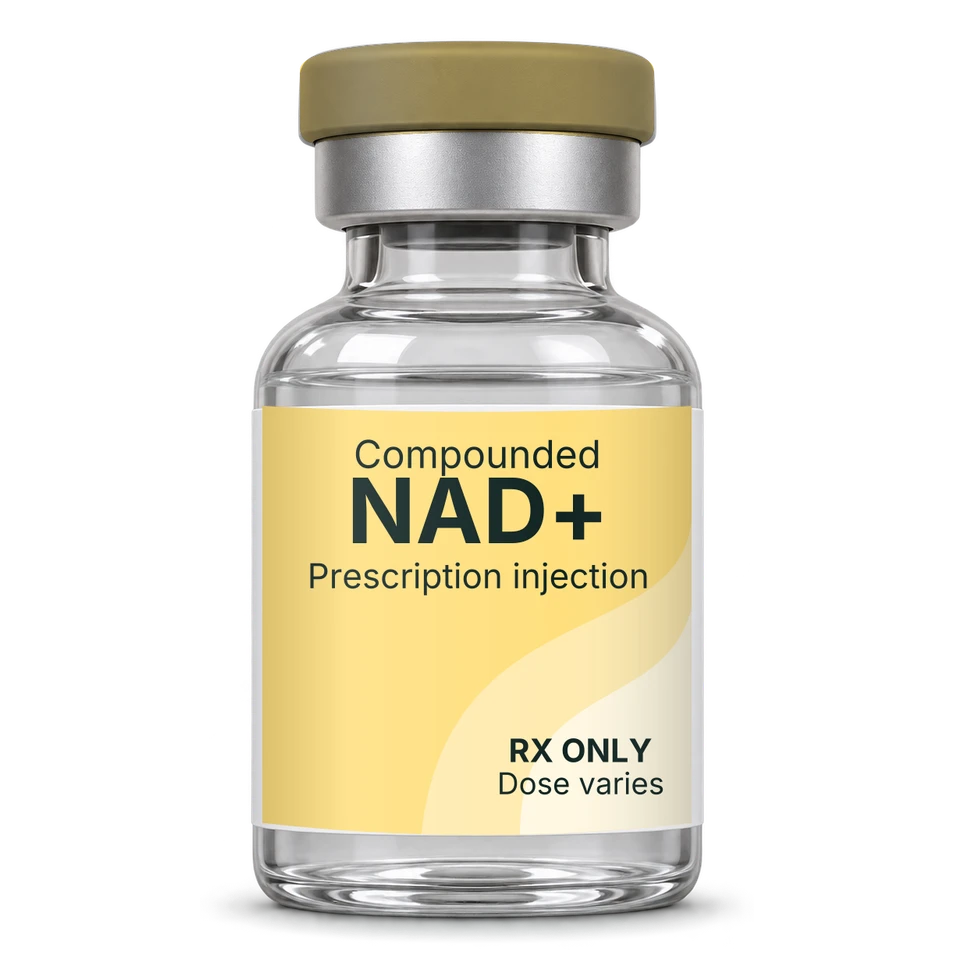


NAD+
Nicotinamide adenine dinucleotide (NAD+) is a vital coenzyme present in every cell that naturally declines with age. Clinician-guided replenishment supports cellular energy metabolism, mitochondrial function, and healthy aging.
$174/mo
Prescribed after a clinician review.
Start the screener 2 min screenerPrivate online screener. A licensed US clinician reviews every request. Safety information
What it is
Included if your clinician prescribes it:
- Compounded NAD+ in a sterile vial from a licensed US pharmacy
- Injection supplies and step-by-step instructions
- An amount and schedule set by your clinician
- Check-ins with your care team
Compounded; not FDA-approved. Individual results vary.
How it’s taken
A small injection into the fatty tissue under the skin, usually the belly or thigh, at home. Your clinician sets the amount and how often, and shows you how to inject and rotate sites. Use only the sterile supplies your pharmacy sends, and never share them.
Who prescribes it
A licensed US clinician reviews your screener and health history, then decides whether NAD+ is appropriate and which form fits you. If it is, a state-licensed US compounding pharmacy prepares it for you.

The potential benefits of NAD+.
Explore NAD+ With a Clinician-
Mitochondrial energy
NAD+ helps your mitochondria turn food into usable energy. In lab and animal studies, restoring NAD+ improved mitochondrial function.
-
Cellular repair
NAD+ fuels sirtuins and PARPs, enzymes that handle DNA repair and cell stress. Restoring it enhanced cellular repair in lab and animal studies.
-
Metabolic health
Animal and lab research linked restored NAD+ with better metabolic markers. Human trials are still small and early.
-
Heart and vessels
Researchers are asking whether NAD+ affects blood pressure and arterial stiffness. It is an open question for future trials.
These findings come from lab, animal and early human research. NAD+ is not proven to slow or reverse aging in people, and individual results vary.
Who NAD+ may be for.
People who ask a clinician about NAD+ often fit one of these. Open one to read more.
NAD+ is compounded and not FDA-approved. It is not an approved treatment for any condition, it does not replace care for sleep, thyroid, nutrient or hormone problems, and individual results are not guaranteed. A licensed clinician reviews your health history, potential benefits and risks, and decides whether it is appropriate.

Tired in a Way Rest Doesn’t Fix?
Researchers link lower NAD+ with weaker mitochondrial output, which may play a part in fatigue. A clinician checks other causes first, such as sleep, thyroid, nutrient or hormone issues, then decides whether NAD+ fits.
Tired in a Way Rest Doesn’t Fix?
Researchers link lower NAD+ with weaker mitochondrial output, which may play a part in fatigue. A clinician checks other causes first, such as sleep, thyroid, nutrient or hormone issues, then decides whether NAD+ fits.
Thinking Feels Slower Than It Used To?
Some people report clearer thinking on NAD+, although no controlled trial has measured it yet. A clinician can walk you through what is known and rule out other causes.
Bouncing Back Slower After Workouts?
Slower recovery is one of the midlife changes researchers connect to falling NAD+ and mitochondrial output. NAD+ is being explored as part of a recovery routine, alongside sleep, food and training.
Noticing Shifts in Your Metabolism?
With age the body tends to make less NAD+ and use more of it. In animal studies, restoring NAD+ improved metabolic markers; whether that carries over to people is still being studied.
Planning for the Years Ahead?
Many people ask about NAD+ as part of a preventive, healthy-aging plan. The animal research is promising, but NAD+ is not proven to slow or reverse aging in people, and your clinician will say so plainly.
Rather Skip the Drip Chair?
IV NAD+ is given slowly, over one to several hours in a clinic. The injection and the spray are taken at home in a few minutes. A clinician can review what you use now and whether a prescription fits.
Not Keen on Needles?
The nasal spray is a needle-free way to take NAD+. It is a different route from an injection, and your clinician will talk through how the two compare for you.
Rather Not Self-Source?
Buying NAD+ online skips the screening your history and medications need. Ours is prescribed by a licensed clinician and prepared by a state-licensed US compounding pharmacy, after FDA warned about injectable NAD+ made with unsuitable ingredients.

How does NAD+ work?
The basic biology, in three steps. How much extra NAD+ does in people is still being studied.
-
01In every cell
NAD+ is a coenzyme your mitochondria use to turn food into ATP, the cell’s energy, and a helper in hundreds of enzyme reactions.
-
02Falls with age
With age the body may make less NAD+ and use more, as PARPs and CD38 consume it and recycling slows. Studies of skin, brain and blood found lower levels in older adults.
-
03Taken two ways
An injection under the skin or a nasal spray delivers NAD+ from outside the cell. How much reaches your cells by each route is still being studied.
This is the basic biology of NAD+. Research on NAD+ injections and nasal sprays in people is early. Compounded NAD+ is not FDA-approved. Individual results vary.
Two ways to take NAD+.
Both forms are compounded NAD+ from a licensed US pharmacy. One is a small injection under the skin, the other a metered nasal spray, and your clinician sets the amount and schedule.
| InjectableUnder the skin | Nasal sprayNeedle-free | |
|---|---|---|
| How it’s taken | A small injection into the fatty tissue of the belly or thigh, at home. | A metered spray into the nose, at home. |
| How often | On the schedule your clinician sets for you. | On the schedule your clinician sets for you. |
| May suit | People comfortable with a small needle, or who already self-inject. | People who would rather avoid needles. |
| Can cause | Redness, stinging or itching where you inject. | Nasal irritation, dryness or a runny nose. |
Absorption differs by route and is still being studied. Your clinician decides which form, if either, is appropriate, and you can switch later. Neither form is FDA-approved.


Your first weeks, step by step.
NAD+ starts with a clinician review and moves at your pace, with check-ins along the way.
-
Week 1
Getting set up°
- Your clinician reviews your history and prescribes only if appropriate
- Learn your form: injection steps or spray technique
- Note how you feel, plus any skin or nasal irritation
-
Week 4
First check-in°
- Review how the routine is going with your clinician
- Talk through any side effects
- Change the amount or schedule only if your clinician advises it
-
Week 8
Taking stock°
- Look back at your notes on how you’ve felt day to day
- Decide with your clinician whether to continue, change form or stop
- Refills only after a review
-
Ongoing
Reviewed, not on autopilot°
- Periodic check-ins with your care team
- Switch format if your needs change
- Message your care team between check-ins
°Illustrative care milestones, not guaranteed outcomes. NAD+ is compounded and not FDA-approved. Many people notice no change, and response varies.
Questions, answered plainly.
Anything else, ask your clinician during your consult.

What is NAD+?
NAD+ (nicotinamide adenine dinucleotide) is a coenzyme in every cell. It helps your mitochondria turn food into energy and powers sirtuins and PARPs, enzymes involved in DNA repair, stress responses and metabolism. Supplements sold as boosters usually contain precursors such as NR or NMN; this is a prescription, compounded form of NAD+ itself.
Is NAD+ FDA-approved?
No. There is no FDA-approved NAD+ injection or nasal spray, and FDA has not reviewed compounded NAD+ for safety or effectiveness. Ours is prepared for you by a state-licensed US compounding pharmacy from a prescription, and only after a licensed clinician decides it is appropriate.
Which form should I choose?
Your clinician decides with you. The injection is a small shot under the skin; the spray is needle-free. They differ in how NAD+ is absorbed, which is still being studied. Your clinician weighs your history, your preferences and how you feel about needles, and you can change form later.
How do I take it?
The injection goes into the fatty tissue of the belly or thigh, rotating sites, using the sterile supplies your pharmacy sends. The spray is a metered pump into the nose, primed as the pharmacy directs. Your clinician sets the amount and schedule for either. Use it exactly as prescribed.
What side effects are reported?
With injections: redness, stinging, itching or a small bump where you inject, and sometimes flushing, nausea, headache or lightheadedness. With the spray: nasal irritation, dryness, congestion or a runny nose, and sometimes headache. Get medical help right away for severe chills, shaking, vomiting, fever, swelling or trouble breathing.
Who shouldn’t use NAD+?
Safety in pregnancy and breastfeeding has not been established. Tell your clinician about every condition you have and every medication and supplement you take, so they can decide whether NAD+ is appropriate. If it isn’t, they will tell you.
How soon would I notice anything?
There is no set timeline. Some people report more energy or clearer thinking, but no controlled trial has measured that, and many notice no change. Your clinician checks in along the way and decides with you whether to continue.
What does it cost?
NAD+ is $174 a month, and it is prescribed only if a clinician approves it. Compounded medications are rarely covered by insurance, so most people pay out of pocket.
Important Safety Information
NAD+ injection and nasal spray
NAD+ (nicotinamide adenine dinucleotide) injection and nasal spray are compounded medications. They are not FDA-approved, and FDA has not evaluated them for safety, effectiveness or quality. A prescription is required; a licensed clinician decides whether NAD+ is appropriate for you.
Before you start
Tell your clinician about all your health conditions, every medication and supplement you take, and whether you are pregnant, planning a pregnancy or breastfeeding. Safety in pregnancy and breastfeeding has not been established.
Possible side effects
Injection: redness, stinging, itching, bruising or a small lump where you inject; flushing, nausea, headache, lightheadedness or tiredness. Nasal spray: nasal irritation, dryness, congestion, runny nose, sneezing or headache.
Get medical help right away
If you have severe chills, shaking, fever, vomiting, a rash, swelling of the face or throat, or trouble breathing. FDA has received reports of reactions like these after some injectable NAD+ products, consistent with contamination from ingredients not suited to sterile use.
Using it safely
Use only the supplies your pharmacy sends. Never share needles, vials or spray bottles. Store it as the pharmacy label directs.
This is not a complete list of side effects. Call your clinician for medical advice. You can report side effects to FDA at 1-800-FDA-1088 or www.fda.gov/medwatch. In an emergency, call 911.
References
- NAD+ - Peptide Center guide
- The Safety and Antiaging Effects of Nicotinamide Mononucleotide in Human Clinical Trials: an Update Advances in nutrition (Bethesda, Md.), 2023
- The efficacy and safety of β-nicotinamide mononucleotide (NMN) supplementation in healthy middle-aged adults: a randomized, multicenter, double-blind, placebo-controlled, parallel-group, dose-dependent clinical trial GeroScience, 2023
- Nicotinamide mononucleotide (NMN) as an anti-aging health product - Promises and safety concerns Journal of advanced research, 2022
- Dietary Supplementation With NAD+-Boosting Compounds in Humans: Current Knowledge and Future Directions The journals of gerontology. Series A, Biological sciences and medical sciences, 2023
- NAD(+) rescues aging-induced blood-brain barrier damage via the CX43-PARP1 axis Neuron, 2023
- NAD(+) Repletion Rescues Female Fertility during Reproductive Aging Cell reports, 2020

More energy for today. An eye on the years ahead.
Put energy and healthy aging at the heart of your routine. Start your assessment to explore NAD+ with a clinician.
Before you start treatment
Share your health history
Start with a health assessment. Include your medical history, current medications, and what you’re looking for help with.
Get a clinician’s assessment
A licensed clinician reviews your information and determines whether treatment is appropriate. A prescription depends on that assessment.
Review your plan
If treatment is recommended, ask how to use it, what side effects to watch for, and when to follow up.
Check availability in your state. Review the total cost and any renewal or cancellation terms before you pay.