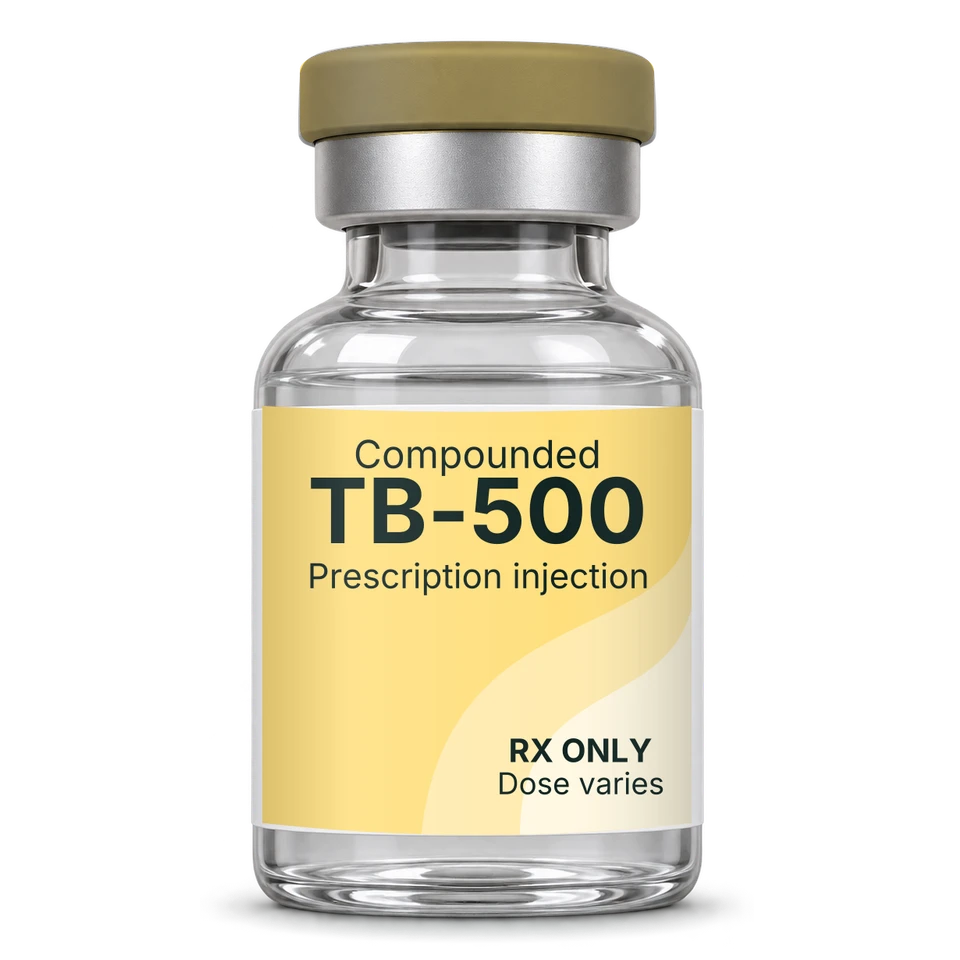

TB-500TB-500
A synthetic thymosin beta-4 peptide fragment prescribed by licensed clinicians to support muscle recovery, flexibility, and tissue repair after physical strain.
- Form
- Injection, as your clinician directs
- FDA status
- Not FDA-approved
- Evidence
- Early, mostly lab and animal studies
- Pricing
- $249/mo
Prescription required. A licensed clinician decides if it’s appropriate.Not yet available. We’ll only offer TB-500 if it can be lawfully prescribed and compounded.
Start the screenerJoin the waitlist 2 min screener1 minPrivate online screener. A licensed US clinician reviews every request.Email only. We’ll write once, when there is news. No health questions.
What it is
In short:
- A synthetic peptide based on the active region of thymosin beta-4, a protein your body releases after injury
- Explored for soft-tissue and connective-tissue recovery
- Studied in the lab for cell movement, new blood vessel growth and inflammatory signaling
- Investigational and not FDA-approved
Results, if any, vary. Many people may notice no change.
How it’s taken
By injection under the skin, only if a clinician prescribes it and exactly as they direct. Your clinician sets the dose and schedule. Never use products sold “for research use only”; they are not made for people.
Who prescribes
A licensed US clinician reviews your screener and health history, then decides whether TB-500 is appropriate for you. If it is, it is prepared by a licensed US compounding pharmacy and shipped to you.When available, a licensed US clinician will review your screener and health history and decide whether TB-500 is appropriate.
Safety information
Investigational; not FDA-approved, and its safety in people has not been established. Do not use if pregnant, trying to conceive or breastfeeding. Tell your clinician about any current or past cancer, any active infection and every medicine you take. Prohibited in tested sport (WADA).

The potential benefits of TB-500.
Explore TB-500 With a ClinicianSoft-tissue recovery
Explored for the repair response after muscle strain and connective-tissue stress, so far mostly in animal research.
Mobility and training
Of interest to active adults for recovery and resilience through hard training or rehab. An area of interest, not a promised result.
Repair cells on the move
Thymosin beta-4 binds actin, which in lab studies helps repair cells travel toward damaged tissue.
Blood flow and inflammation
Preclinical studies suggest it may support new small blood vessels and calm inflammatory signaling around an injury.
Based mostly on lab and animal research, much of it on full-length thymosin beta-4 rather than the TB-500 fragment. A 2026 review found that recovery benefits in people have not been shown. Not evaluated by the FDA. Results, if any, vary.
Who TB-500 may be for.
People who explore TB-500 with a clinician often fit one of these. Open one to read more.
TB-500 is investigational and not FDA-approved. These describe who may explore it with a clinician; they are not approved uses, and evidence in people is limited. A licensed clinician reviews your history, potential benefits and risks, and decides whether it’s appropriate. TB-500 does not replace established care.

For the Strain That Lingers.
Recovery after soft-tissue strain is the main area of interest for TB-500. In animal studies, thymosin beta-4 has been explored for the repair response after injury. Evidence in people is limited.
For the Strain That Lingers.
Recovery after soft-tissue strain is the main area of interest for TB-500. In animal studies, thymosin beta-4 has been explored for the repair response after injury. Evidence in people is limited.
When Connective Tissue Takes the Load.
Tendons and ligaments heal slowly and carry stress in almost every sport. Researchers have explored TB-500 for connective-tissue repair, mostly in animal models.
For the Weeks Training Asks a Lot.
Musculoskeletal recovery and resilience during demanding training are why many active adults ask about TB-500. It is prohibited at all times in tested sport.
Easing Back In.
TB-500 is sometimes discussed alongside a structured rehab plan, never instead of one. A clinician can talk through whether it may play a supporting role.
Still Moving, Decade After Decade.
General wear from years of running, lifting and playing is another area of interest. Researchers have not yet shown recovery benefits in people.
One Piece of a Bigger Plan.
Some clinicians consider TB-500 as one tool alongside labs, hormone care and training changes. Sleep, load management and physical therapy still come first.
For the Saturday League and the Sunday Long Run.
Weekend sport can be hard on tissue that sits still all week. A clinician can help you weigh TB-500 against simpler options first, and tell you when it is not a fit.
Curious About Peptides, Not About Guesswork.
Peptides sold online for research use have unverified purity and dose. A licensed clinician can review your history and labs, go through the evidence and the risks with you, and decide whether anything is appropriate.

How does TB-500 work?
The leading theory, in three steps. Most of it comes from lab and animal research.
01Holds on to actin
Thymosin beta-4 binds actin, the building block cells use to move. TB-500 copies the short region that does this.
02Cells may move in
In lab models, this helps repair cells travel toward injured tissue. Researchers think it may also support new small blood vessels.
03A clinician decides
Evidence in people is limited, so a licensed clinician reviews your history first. Not everyone is a candidate.
This is the proposed mechanism, based mainly on lab and animal studies of thymosin beta-4. TB-500 is not FDA-approved, and human data are limited.
A Fragment, Not the Whole Protein.
Thymosin beta-4 is a protein of 43 amino acids. TB-500 is built on just 7 of them, the short stretch linked to how cells move and repair.
Amino acid counts describe the molecules, not a dose. Most human research used full-length thymosin beta-4, not the TB-500 fragment. If a clinician prescribes it, they set the dose and schedule.
Small Steps. Progress Over Time.
TB-500 is investigational, so care is built around review and honest check-ins, not promises.
Week 1
Review and Start°
- A clinician reviews your history and goals
- If prescribed, learn injection technique and storage
- Note a baseline for training, soreness and sleep
Week 4
First Check-in°
- Report any side effects or injection-site reactions
- Compare your notes against your baseline
- Your clinician decides whether to continue, adjust or stop
Week 8
An Honest Review°
- Look at what has changed, and what hasn’t
- Weigh it alongside rehab and training changes
- Decide next steps with your clinician
Ongoing
Supervised, or Stopped°
- Continue only if your clinician agrees it’s appropriate
- Regular check-ins while on treatment
- Stopping is always an option
°Illustrative care milestones, not guaranteed outcomes. TB-500 is investigational; benefits and response times are not established, and many people may notice no change.
Questions, answered plainly.
Anything else, ask your clinician during your consult.

What is TB-500?
TB-500 is a synthetic peptide based on a short active region of thymosin beta-4, a protein your body makes and releases after injury. FDA identifies it by its seven-amino-acid sequence, LKKTETQ. It is investigational: it has not been approved by the FDA, and studies in people are very limited.
Is TB-500 FDA-approved?
No. TB-500 is not FDA-approved for any use. In July 2026 an FDA advisory committee voted to recommend it for the list of substances pharmacies may compound, but that vote is advisory and FDA has not acted on it. Aurelius Health Group will only make it available if it can be lawfully prescribed and compounded by a licensed US pharmacy.
Who shouldn’t use TB-500?
Anyone pregnant, trying to conceive or breastfeeding, because safety hasn’t been studied. People with a current or past cancer or an active infection, since thymosin beta-4 affects how cells grow and move. Athletes in tested sport: TB-500 is on the World Anti-Doping Agency’s prohibited list. Your clinician will review your full history and medications.
Is there evidence it works in people?
Very little. Most research is in lab and animal models. Two small phase 2 trials of full-length thymosin beta-4, not TB-500, studied chronic skin wounds and reported faster healing in patients whose wounds healed. A 2026 review of TB-500 and similar peptides found that recovery benefits in people have not been shown. That is why a clinician reviews every request.
What side effects are possible?
Human safety is largely unstudied. People describe temporary tiredness and redness or irritation where they inject, and FDA has warned that compounded TB-500 may carry a risk of immune reactions. Tell your care team about anything that concerns you, and get help right away if you notice signs of an allergic reaction.
How is it taken?
Usually by injection under the skin, only if a clinician prescribes it and exactly as they direct. Your clinician sets the dose and schedule for you. Products sold online for research use only have unverified purity and dose and are not made for people.
Does it replace physical therapy or my doctor?
No. TB-500 is not a substitute for rest, rehab or care from your own clinicians. Keep your existing clinicians informed, and never stop a prescribed treatment without talking to the clinician who prescribed it.
What does it cost? Is it covered by insurance?
Insurance does not cover investigational peptides. TB-500 is $249 a month, and it is only prescribed if a clinician approves it.
References
- TB-500 - Peptide Center guide
- Thymosin β4: a multi-functional regenerative peptide. Basic properties and clinical applications Expert opinion on biological therapy, 2012
- Thymosin β(4) and β(10) Expression in Human Organs during Development: A Review Cells, 2024
- Thymosin β4 Promotes Dermal Healing Vitamins and hormones, 2016
- Thymosin beta 4-like peptides Methods in enzymology, 1985
- Thymosin beta-4 denotes new directions towards developing prosperous anti-aging regenerative therapies International immunopharmacology, 2023
- Sources of variability in quantifying circulating thymosin beta-4: literature review and recommendations Expert opinion on biological therapy, 2018

Stay in the game you love.
Make mobility and a return to your favorite activities the goal. Explore TB-500 with a clinician.
Before you start treatment
Share your health history
Start with a health assessment. Include your medical history, current medications, and what you’re looking for help with.
Get a clinician’s assessment
A licensed clinician reviews your information and determines whether treatment is appropriate. A prescription depends on that assessment.
Review your plan
If treatment is recommended, ask how to use it, what side effects to watch for, and when to follow up.
Check availability in your state. Review the total cost and any renewal or cancellation terms before you pay.