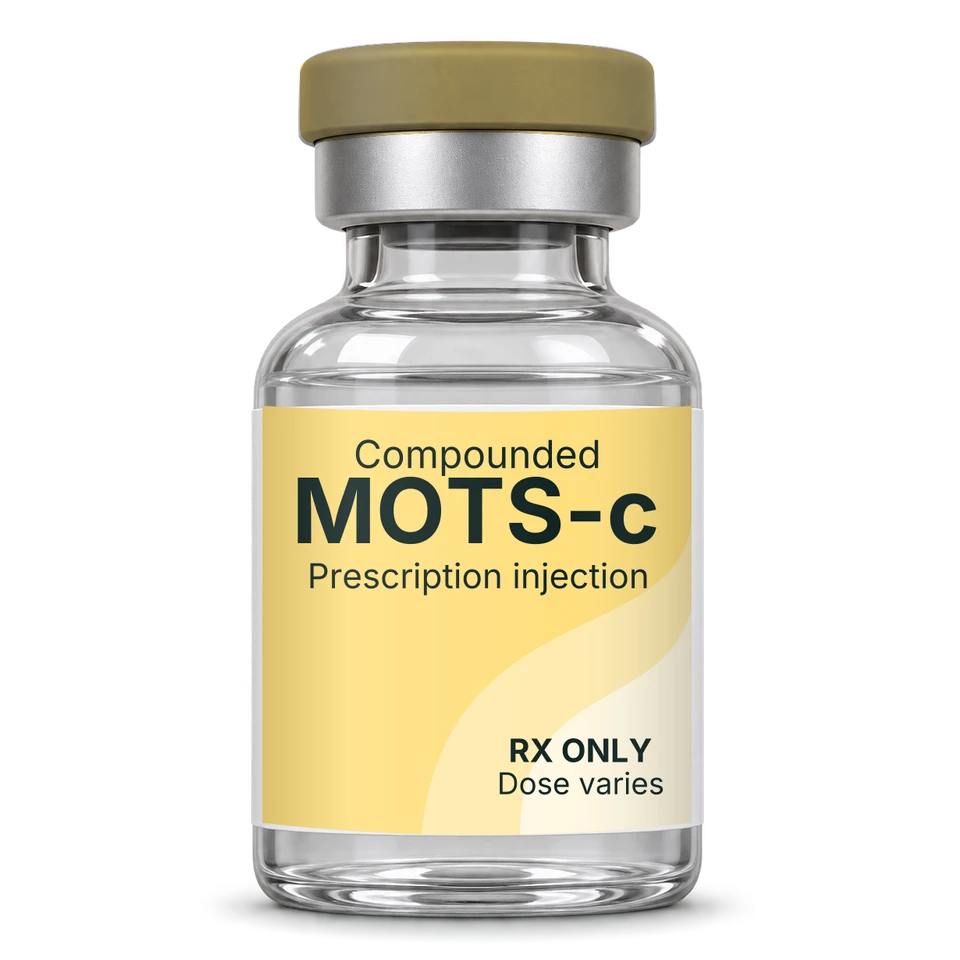


MOTS-01MOTS-c (Compounded)
A mitochondrial-derived peptide prescribed in clinician-led longevity protocols to support cellular energy metabolism, exercise resilience, and metabolic flexibility.
$164/mo
Not FDA-approved. Prescription required.
Start the screener 2 min screenerPrivate online screener. A licensed US clinician reviews every request.
What it is
What to know:
- A 16-amino-acid peptide encoded in your mitochondrial DNA
- Made by your body: levels rise with exercise and fall with age
- Studied for metabolism, insulin sensitivity and exercise capacity
- Investigational: not FDA-approved for any use
Human research is limited. Benefits in people are not established, and results may vary.
How it’s taken
By injection under the skin, if prescribed. Your clinician sets the dose and schedule, and your care team shows you how to inject. Use it only as prescribed.
Who prescribes
A licensed US clinician reviews your screener, health history and current medications, then decides whether MOTS-c is appropriate. If it isn’t, they’ll tell you why.
Safety information
MOTS-c is investigational and not FDA-approved, and long-term safety in people is unknown. As with any injection, redness, swelling or soreness at the site can occur. Not for use during pregnancy or breastfeeding, or under 18. Prohibited in sport under WADA rules. Tell your clinician about every medication and condition.

The potential benefits of MOTS-c.
Explore MOTS-c With a ClinicianFuel use in muscle
May help muscle burn glucose and fat instead of storing them. MOTS-c switches on AMPK, the cell’s energy sensor, mainly in skeletal muscle.
Insulin sensitivity
In mice, MOTS-c prevented insulin resistance caused by aging and by a high-fat diet. A human trial in adults with prediabetes is under way.
Diet and weight
In mice on a high-fat diet, MOTS-c prevented diet-induced weight gain, most clearly in males. This has not been shown in people.
Physical capacity with age
MOTS-c improved physical performance in young, middle-aged and old mice, even when started late in life. Exercise raises it in people.
MOTS-c is investigational. Most research is in cells and animals, and benefits in people are not established.
Who MOTS-c may be for.
People who explore MOTS-c with a clinician often share one of these goals. Select one to read more.
MOTS-c is investigational and not FDA-approved. Evidence in people is limited, and individual results are not guaranteed. A licensed clinician reviews your health history, potential benefits, risks and suitability. MOTS-c does not replace established care.

When blood sugar control starts to slip.
MOTS-c is being studied for insulin sensitivity. In mice it prevented insulin resistance caused by aging and by a high-fat diet, and a Phase 2a trial is now testing it in 120 adults with prediabetes and overweight. Results are not in yet.
When blood sugar control starts to slip.
MOTS-c is being studied for insulin sensitivity. In mice it prevented insulin resistance caused by aging and by a high-fat diet, and a Phase 2a trial is now testing it in 120 adults with prediabetes and overweight. Results are not in yet.
A metabolism that has slowed down.
In mice fed a high-fat diet, MOTS-c prevented diet-induced weight gain and improved glucose tolerance, most clearly in males. No human trial has shown weight loss yet, so a clinician walks you through what the evidence can and cannot tell you.
Using fuel instead of storing it.
MOTS-c switches on AMPK, an enzyme that senses cellular energy, nudging skeletal muscle to use glucose and fat rather than store them. Researchers describe it as a signal that mimics part of the body’s response to training.
Keeping up as the years add up.
In mice, MOTS-c improved physical capacity at every age tested, even when treatment began late in life. In people, natural MOTS-c levels fall with age, which is why it is being explored in healthy-aging research.
You already move. You want to understand more.
Exercise raises your own MOTS-c in muscle and blood, which is why researchers study it alongside training. In animal studies the biggest effects were in older or overweight animals, not fit ones. It is prohibited in tested sport under WADA rules.
Planning for the decades ahead.
Circulating MOTS-c declines with age and with metabolic dysfunction. Animal results were strongest where metabolism was already under strain, which is why midlife metabolic health is a focus of the research.
Part of the care you already have.
MOTS-c acts mainly in muscle, while metformin acts mainly in the liver, and both work through AMPK. Your clinician checks for interactions first, and MOTS-c is discussed alongside your current care, never in place of it.
Honest answers about an early-stage peptide.
No human trial has yet shown that MOTS-c causes weight loss, better insulin sensitivity or more exercise capacity. A clinician can weigh the animal evidence, the open questions and the unknown long-term safety with you.

How does MOTS-c work?
The leading theory, in three steps, mostly from lab and animal studies. Researchers are still working out the details.
01Made in your mitochondria
MOTS-c is a short peptide, 16 amino acids long, encoded in mitochondrial DNA. Your body makes it on its own.
02Signals the energy sensor
In lab studies, MOTS-c activates AMPK, the enzyme cells use to sense their energy supply.
03Responds to stress
Under metabolic stress, MOTS-c has been seen moving into the cell nucleus, where it may influence genes linked to stress responses.
This is the proposed mechanism from cell and animal research. How it applies in people is still being studied. MOTS-c is investigational and not FDA-approved.

A small peptide. A prescribed approach.
MOTS-c is a peptide just 16 amino acids long, encoded in your mitochondrial DNA and, if it’s prescribed, given as an injection on a schedule your clinician sets.
Peptide length from Lee et al., Cell Metabolism, 2015. No dose is shown here: there is no FDA-approved dose for MOTS-c, and your clinician decides whether and how to prescribe it.

Progress over time.
MOTS-c is investigational, so care is built around check-ins. You and your clinician decide together, at every step, whether to continue.
Week 1
Getting started°
- A clinician reviews your history and goals
- If prescribed, your care team shows you how to inject
- Start a simple log of energy, sleep and activity
Week 4
First check-in°
- Share how you feel and anything unexpected
- Report any injection-site or other side effects
- Your clinician reviews whether to continue
Week 8
Review together°
- Look back at your log with your clinician
- Talk through what you have and haven’t noticed
- Decide together whether MOTS-c still makes sense
Ongoing
Ongoing support°
- Regular check-ins while you continue
- Updates as the research and regulations change
- Stop at any time, with your clinician’s guidance
°Illustrative care milestones, not guaranteed outcomes. MOTS-c is investigational. Benefits in people are not established, and many people may notice no change.
Questions, answered plainly.
Anything else, ask your clinician during your consult.

What is MOTS-c?
MOTS-c is a peptide, 16 amino acids long, that your body makes on its own. It is encoded in mitochondrial DNA, which is unusual, and it was first described in 2015. Researchers are studying its role in how cells handle energy, mostly in lab and animal studies so far.
What is MOTS-c?
MOTS-c is a peptide, 16 amino acids long, that your body makes on its own. It is encoded in mitochondrial DNA, which is unusual, and it was first described in 2015. Researchers are studying its role in how cells handle energy, mostly in lab and animal studies so far.
Is MOTS-c FDA-approved?
No. MOTS-c is not FDA-approved for any use. In July 2026 an FDA advisory committee voted to recommend that pharmacies be allowed to compound it, but FDA has not acted on that vote. Compounded medications are not FDA-approved. We only offer MOTS-c where a licensed US pharmacy can lawfully prepare it.
What does the research show so far?
In mice, MOTS-c prevented insulin resistance and diet-induced weight gain, and improved physical performance at every age. In people, exercise raises natural MOTS-c and levels fall with age. A related compound, CB4211, finished early safety trials, and a Phase 2a trial of MOTS-c in adults with prediabetes began in 2026. No human trial has shown a benefit yet.
How is it taken?
If your clinician prescribes it, MOTS-c is given as an injection under the skin. Your clinician sets the dose and schedule. We don’t publish a dose because no dose is established. Your care team shows you how to inject safely.
What are the possible side effects?
Side effects of MOTS-c itself have not been measured in a controlled trial. In early trials of a related compound, the main issue was injection-site reactions such as small bumps. As with any injection, redness, swelling or soreness can occur. Tell your care team about anything that concerns you, and get urgent care for a severe reaction.
Who shouldn’t use MOTS-c?
Anyone who is pregnant or breastfeeding, and anyone under 18. Tell your clinician about every condition and medication, especially metformin or any other medicine that affects blood sugar, since MOTS-c works through the same energy pathway (AMPK). Mention any liver condition too.
Is MOTS-c allowed in sport?
No. The World Anti-Doping Agency lists MOTS-c as prohibited at all times. If you compete in tested sport, tell your clinician before you start the screener.
Does insurance cover it?
No. MOTS-c is investigational, so insurance doesn’t cover it and you pay out of pocket. MOTS-c is $164 a month. You are charged for medication only if a clinician prescribes it.

Power for the life you want.
Make steadier afternoons and more energetic evenings your goal. Start your assessment to explore MOTS-c with a clinician.
Before you start treatment
Share your health history
Start with a health assessment. Include your medical history, current medications, and what you’re looking for help with.
Get a clinician’s assessment
A licensed clinician reviews your information and determines whether treatment is appropriate. A prescription depends on that assessment.
Review your plan
If treatment is recommended, ask how to use it, what side effects to watch for, and when to follow up.
Check availability in your state. Review the total cost and any renewal or cancellation terms before you pay.