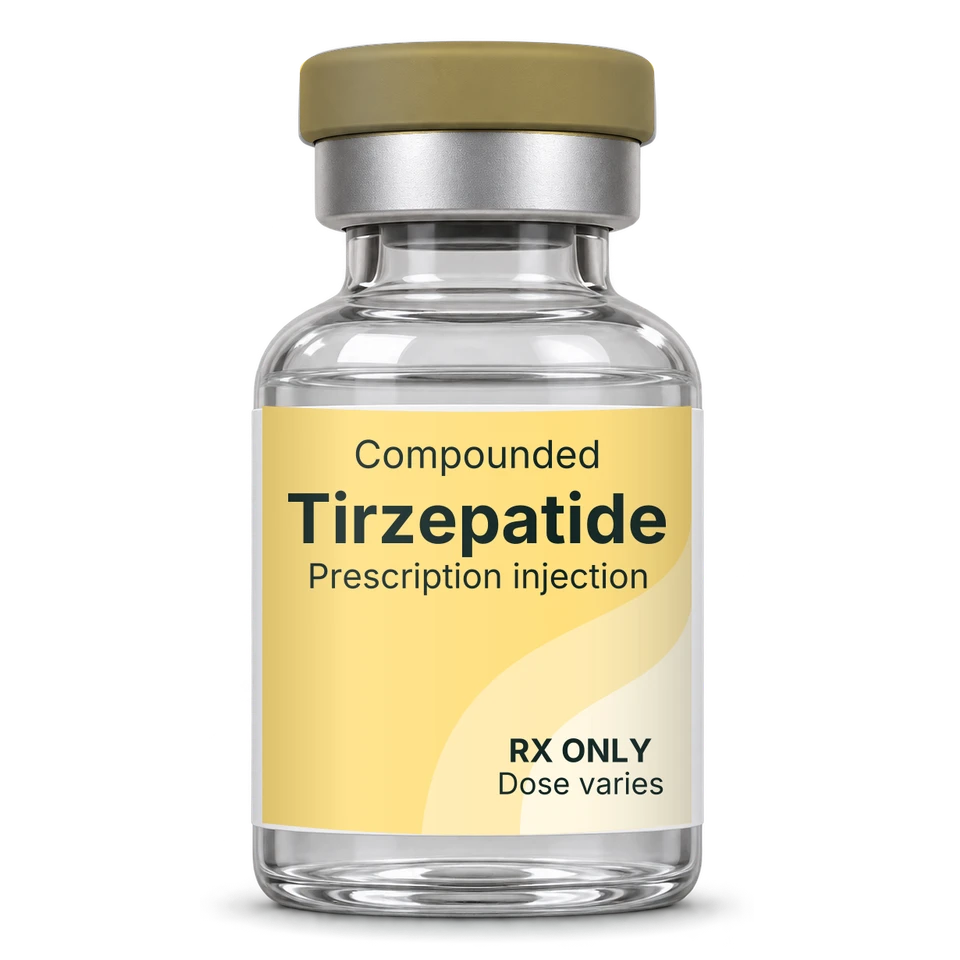


RxTirzepatide (Compounded)
A once-weekly prescription injection that activates both GIP and GLP-1 hormone receptors to support appetite regulation, satiety, and long-term weight management alongside clinician guidance.
Prescribed only after a physician review.
Start your intake 2 minAbout two minutes. A licensed US physician reviews every intake.
What’s included
Your plan includes:
- A consultation with a licensed MD or DO
- Your medication, prepared by a licensed US pharmacy
- Monthly check-ins, with dose changes only when your physician decides
- Secure messaging with your care team
Individual results vary.
How it’s used
A small injection under the skin, on the schedule your physician sets. Your care team walks you through it before your first dose. Keep the vial in the fridge, at 2 to 8 °C.
Safety information
Compounded tirzepatide, as an injection, is not FDA-approved. Not for anyone with a personal or family history of medullary thyroid carcinoma or MEN 2, or who is pregnant. See Important Safety Information below.

The potential benefits of tirzepatide.
Explore With a PhysicianMeaningful weight loss
Paired with changes to food and activity, brand-name tirzepatide led to meaningful weight loss for many adults in clinical trials.
Less food noise
Many people report fewer cravings, feeling full sooner and less time spent thinking about food.
Metabolic health
Research suggests improvements in several metabolic markers, including blood sugar regulation.
What it’s approved for
Brand-name tirzepatide is FDA-approved for chronic weight management and, separately, for type 2 diabetes. Compounded tirzepatide is not FDA-approved.
Results described are from clinical trials of brand-name tirzepatide. Compounded tirzepatide is not FDA-approved and was not studied in these trials. Individual results vary.
Who tirzepatide may be for.
These are the starting points your physician looks at. Open one to read more.
Brand-name tirzepatide is labelled for adults with a BMI of 30 or more, or 27 or more with a weight-related condition. Eligibility is decided by a licensed physician after reviewing your full health history. Compounded tirzepatide is not FDA-approved, and individual results vary.

A Plan Built Around You.
Brand-name tirzepatide is labelled for adults with a BMI of 30 or more. Your physician reviews your history, your goals and anything you have tried before, then decides whether compounded tirzepatide is appropriate for you.
A Plan Built Around You.
Brand-name tirzepatide is labelled for adults with a BMI of 30 or more. Your physician reviews your history, your goals and anything you have tried before, then decides whether compounded tirzepatide is appropriate for you.
Your Health, Looked at Whole.
Brand-name tirzepatide is also labelled for adults with a BMI of 27 or more who have at least one weight-related condition. Your physician reviews the full picture before deciding whether compounded tirzepatide is appropriate.
Not Instead Of. Alongside.
Tirzepatide is used together with changes to food and activity, not in place of them. Your physician and care team help you keep both in the plan.
Where You’ve Been Shapes Where You Start.
If you have taken a medicine in this class before, your physician will ask which one, what dose and how it went, and set your starting point with that in mind.
More Than the Number on the Scale.
Research on brand-name tirzepatide suggests improvements in several metabolic markers, including blood sugar regulation. Your physician may order labs to see where you are starting.
A Physician in the Loop.
Each month your physician reviews how you are doing, including any side effects, and decides whether to hold or adjust your dose. You can message your care team in between.

How does tirzepatide work?
The short version, in three steps. Your physician walks you through the rest during your consult.
-
01Two signals at once
Tirzepatide activates two receptors, GLP-1 and GIP. Your body normally uses both to send signals after you eat.
-
02Fuller, sooner
Those signals may help you feel full sooner and slow how quickly your stomach empties, so smaller portions can feel easier.
-
03Dosed to you
Your physician starts you low and adjusts slowly, based on how you respond. Not everyone responds the same way.
How tirzepatide works is described from the FDA label for brand-name tirzepatide. Compounded tirzepatide is not FDA-approved. Individual results vary.
A Smaller Dose. A Personalized Approach.
Brand-name tirzepatide is labelled from 2.5 mg to 15 mg a week. Your plan starts at the low end, and your physician decides every step after.
Doses shown are on the FDA label for brand-name tirzepatide. Compounded tirzepatide is not FDA-approved. Your physician sets your starting dose and may adjust it gradually, up or down.


Small Doses. Progress Over Time.
Tirzepatide is always started at a low dose and adjusted gradually, based on how your body responds.
Week 1
Getting Started
- A low starting dose, if your physician prescribes
- Your care team shows you how to inject and store it
- Notice how you feel from day to day
Week 4
First Check-In
- Talk through how you are feeling, including side effects
- Your physician decides whether to hold or adjust your dose
- Message your care team anytime in between
Week 8
Settling In
- A second review of your dose and routine
- Changes stay small and deliberate
- Food, movement and sleep stay part of the plan
Ongoing
Your Dose, Reviewed
- Monthly check-ins for as long as you are in the program
- Your dose can move up, down or stay where it is
- Cancel anytime before your next billing date
°Illustrative program milestones, not expected results. Your physician sets your plan and its timing. Individual results vary.
Questions, answered plainly.
Anything else, ask your physician during your consult.

What is compounded tirzepatide?
Tirzepatide is the active ingredient in some brand-name medicines. Compounded tirzepatide is prepared by a licensed US compounding pharmacy and prescribed only when a licensed physician decides it suits your needs. Compounded medications are not FDA-approved.
What is compounded tirzepatide?
Tirzepatide is the active ingredient in some brand-name medicines. Compounded tirzepatide is prepared by a licensed US compounding pharmacy and prescribed only when a licensed physician decides it suits your needs. Compounded medications are not FDA-approved.
Can I switch from another GLP-1?
Often, yes. Your physician asks which medicine you took, at what dose and how it went, then decides whether to switch you and where to start. Never stop or change a prescribed medicine without talking to the doctor who prescribed it.
How much does it cost?
You can cancel anytime before your next billing date, and there are no long-term contracts.
Do I need insurance?
No. The program is self-pay:
Is it FDA-approved?
No. Compounded medications are not FDA-approved, and the FDA does not review them for safety, effectiveness or quality. A licensed physician evaluates your history before anything is prescribed, and a licensed US pharmacy prepares it.
How is it taken?
As a small injection under the skin, on the schedule your physician sets. Your care team walks you through it before your first dose. Keep the vial in the fridge, at 2 to 8 °C.
What side effects are common?
The most commonly reported side effects of tirzepatide are stomach-related: nausea, diarrhea, vomiting, constipation, indigestion and stomach pain. Tell your care team about anything that concerns you; your physician may adjust your dose.
Who should not take it?
Anyone with a personal or family history of medullary thyroid carcinoma or MEN 2, anyone who is pregnant, and anyone who has had a serious allergic reaction to tirzepatide. Tell your physician about past pancreatitis or gallbladder disease, diabetes medicines such as insulin, and birth control pills.
Who decides whether it is right for me?
A licensed MD or DO reviews your intake and health history and decides whether compounded tirzepatide is appropriate for you. If it is not, nothing is prescribed.
Important Safety Information
Compounded tirzepatideCompounded tirzepatide, as an injection, is not FDA-approved. The FDA does not review compounded medications for safety, effectiveness or quality. It is available by prescription only, after a licensed physician decides it is appropriate for you.
Possible thyroid tumors, including cancer. In studies in rodents, tirzepatide caused thyroid C-cell tumors. It is not known whether it causes these tumors, including medullary thyroid carcinoma (MTC), in people. Do not use it if you or a family member have ever had MTC, or if you have multiple endocrine neoplasia syndrome type 2 (MEN 2). Tell your physician about a lump or swelling in your neck, hoarseness, trouble swallowing or shortness of breath.
Do not use it if you are pregnant, or if you have had a serious allergic reaction to tirzepatide or any of its ingredients.
Before you start, tell your physician if you have had pancreatitis, gallbladder problems, kidney problems, severe stomach or digestion problems, or diabetic eye disease, and about every medication you take. Insulin and some diabetes medicines can raise the risk of low blood sugar. Tirzepatide can make birth control pills less reliable for 4 weeks after starting and after each dose increase.
Common side effects include nausea, diarrhea, vomiting, constipation, indigestion and stomach pain. Get medical help right away for severe stomach pain that will not go away, signs of an allergic reaction, or signs of dehydration.
This is not a complete list of risks. Talk with your physician about your full medical history before you start.

Tirzepatide
Less food noise. More room for life.
Take the next step toward appetite control and your weight goals. See if compounded tirzepatide fits.
Before you start treatment
Share your health history
Start with a health assessment. Include your medical history, current medications, and what you’re looking for help with.
Get a clinician’s assessment
A licensed clinician reviews your information and determines whether treatment is appropriate. A prescription depends on that assessment.
Review your plan
If treatment is recommended, ask how to use it, what side effects to watch for, and when to follow up.
Check availability in your state. Review the total cost and any renewal or cancellation terms before you pay.